 Sorta
US + Canada
Seed Catalogue Triage: Don't Buy a Second Garden
Before you order 40 kinds of tomato: find out which of last year's seeds are still alive. Ten seeds, one paper towel.
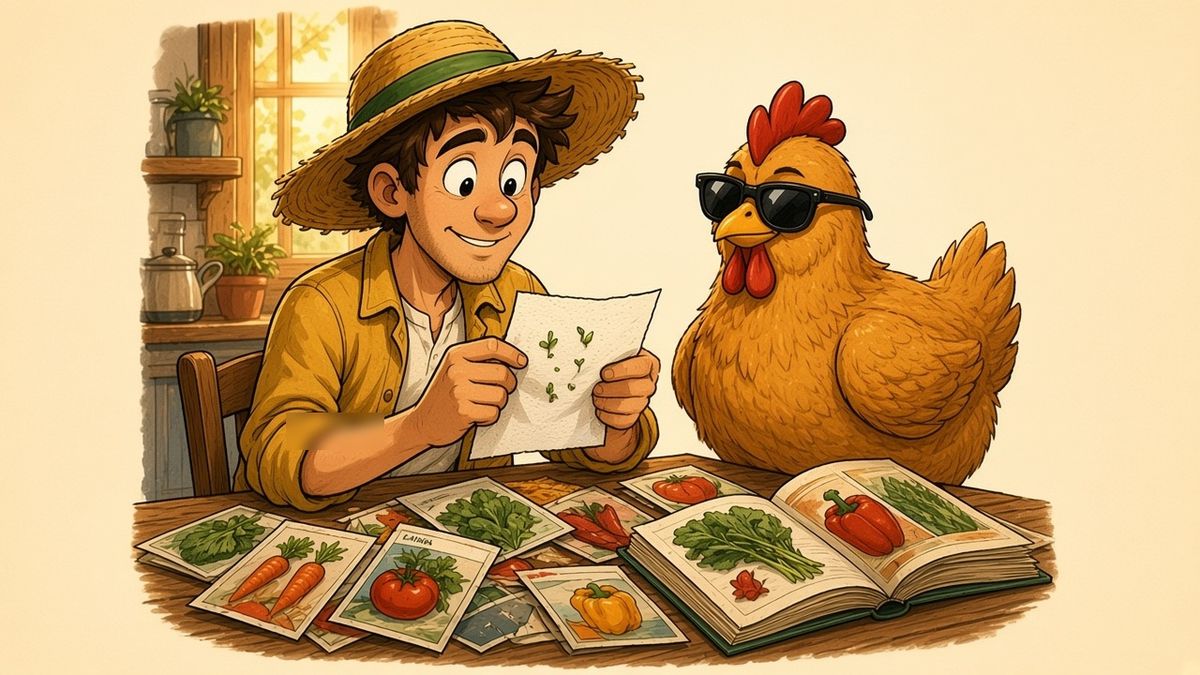
It's catalogue season: what feels like 400 varieties of tomato, each described like a love poem. Before you order, two things: go through the box of leftover seeds from last year, and give your wish list a ruthless edit.
Step 1: Raid what you already own
UNL Extension says leftover vegetable seed can usually be saved for next year "with little loss in germination" if stored properly, and that seed kept longer than a year needs extra care [1]. Storage life depends on temperature, humidity and seed moisture, and varies a lot by species. Keeping seed dry and cold lengthens it [1].
Their table of "relative longevity under cool, dry conditions" (years) gives a rough guide [1]: - 1 year: onion, parsley, parsnip, salsify - 2 years: pepper, sweet corn, okra - 3 years: tomato, carrot, pea, snap bean, spinach, broccoli - 4 years: beets, cabbage, kale, squash, pumpkin, Swiss chard - 5 years: lettuce, cucumber, radish - 6 years: leek
(These figures come from a 1979 and a 1988 handbook cited by UNL; treat them as a guide, not a guarantee [1].)
Step 2: Test it, don't guess
UNL's method for any seed stored over a year [1]: 1. Count out 25 or 50 seeds. 2. Place them between damp paper towels (or muslin/blotting paper) in a dish; moisten and cover so they don't dry out. 3. Keep at 70-75°F (about 21-24°C). 4. Remove and count seeds as they sprout; make a final count after two to three weeks. 5. Work out the percentage. If it's poor, discard and buy fresh [1].
If germination is lowered but not terrible, UNL says the seed may still be fine sown at higher than usual rates, though weak seedlings die more often once in soil [1]. For reference, UNL lists federal minimum germination percentages, for example 70% for onion, 75% for tomato and 80% for lettuce [1]. In Canada, the Seeds Regulations set the minimum germination for graded seed at 75% for onion, 75% for tomato and 70% for lettuce [2]. Those are standards for seed sold in Canada, so use them as a yardstick for your own test results, not as a rule for seed you saved yourself. CFIA also says vegetable and herb seed of listed kinds must be labelled with its germination percentage and the year it was tested [3], so check the year on the packet.
Step 3: Triage the catalogue (our method)
Make three lists: - Must: crops you actually eat and have grown successfully. - Maybe: things that fit your season length. Check days to maturity against your frost-free window instead of the catalogue's zone map. Look up your own average last spring and first fall frost: in the US, NOAA's 1991-2020 U.S. Climate Normals or your state Extension office [7]; in Canada, ECCC's Canadian Climate Normals for your nearest station [4]. Those are 50/50 dates, so half of years run later. - Experiment: one new thing per category. One. Not eleven.
Then subtract what's already in your seed box that passed the test. This is where most of us get caught: it's January, everything sounds amazing, and the order quietly grows to three kinds of squash, five tomatoes and a melon that needs a longer summer than you'll get. Come spring there's no room, no time and a stack of unopened packets. If a seed isn't on one of the three lists, it doesn't go in the cart.
Buying seed across the border?
Canadians buying from a US catalogue: CFIA says "small lots" of seed (under 5 kg of large-seeded kinds such as peas, beans and corn, or under 500 g of small-seeded kinds such as carrot) are exempt from import declaration and seed analysis paperwork, and most gardener orders fall in that group [3]. The seed still must be free of Canadian prohibited noxious weed seeds [3]. That covers the Seeds Act; other laws, such as plant-health rules, can also apply [8]. CFIA says most plants and plant products from the continental US don't need an import permit, and points importers to its Automated Import Reference System (AIRS) to check a specific item [9][10]. Run your order through AIRS before you click buy.
Americans buying from a Canadian catalogue: It's stricter going south. USDA APHIS says all seed for planting produced in Canada needs some form of paperwork, either a phytosanitary certificate from CFIA or an APHIS Small Lots of Seed permit, and it suggests buying your seed in the US [11]. The small-lots permit (PPQ 587, applied for through APHIS eFile) has conditions: for example, at most 50 seeds or 10 grams of one kind per packet, at most 50 packets per shipment, labelled and pesticide-free seed, and no tomato or pepper seed under this permit [12]. APHIS says the process can take up to two months [12]. Check APHIS's pages, or call its Plant Import Information Line at 877-770-5990, before you order [11].
Cheap-farmer note
Seed is among the cheapest inputs in the garden, which is exactly why it's the easiest place to overspend by accident. A 20-minute germination test is a nice use of a snowy afternoon.
Sources
- [1] Lindgren, D.T. and Browning, S.J. "Vegetable Garden Seed Storage and Germination Requirements" (G2090). University of Nebraska-Lincoln Extension. https://extensionpubs.unl.edu/publication/g2090/na/html/view
- [2] Seeds Regulations (C.R.C., c. 1400), Schedule I, Table XX (minimum percentage of germination). Justice Laws Website, current to 2026-09-30. https://laws-lois.justice.gc.ca/eng/regulations/C.R.C.,_c._1400/section-sched511904.html
- [3] Canadian Food Inspection Agency. "Importing small packet seed into Canada." https://inspection.canada.ca/en/plant-health/seeds/seed-imports/small-packet-seed
- [4] Environment and Climate Change Canada. Canadian Climate Normals. https://climate.weather.gc.ca/climate_normals/
- [7] NOAA NCEI. U.S. Climate Normals 1991-2020. https://www.ncei.noaa.gov/products/land-based-station/us-climate-normals
- [8] Canadian Food Inspection Agency. "ABCs of seed importation into Canada." https://inspection.canada.ca/en/plant-health/seeds/seed-imports/abcs-seed-importation
- [9] Canadian Food Inspection Agency. "Before you apply for a permit to import plants or plant products." https://inspection.canada.ca/en/plant-health/invasive-pests-and-plants/plant-import/you-apply-permit
- [10] Canadian Food Inspection Agency. Automated Import Reference System (AIRS). https://inspection.canada.ca/en/importing-food-plants-animals/airs
- [11] USDA APHIS. "Traveling into the United States From Canada at Land Borders" (Seeds). https://www.aphis.usda.gov/traveling-with-ag-products/traveling-united-states-canada-land-borders
- [12] USDA APHIS. "Seeds With Special Requirements and Prohibited Seeds" (Small Lots of Seed). https://www.aphis.usda.gov/plant-imports/buy-plants-seeds-online/seeds-additional-requirements